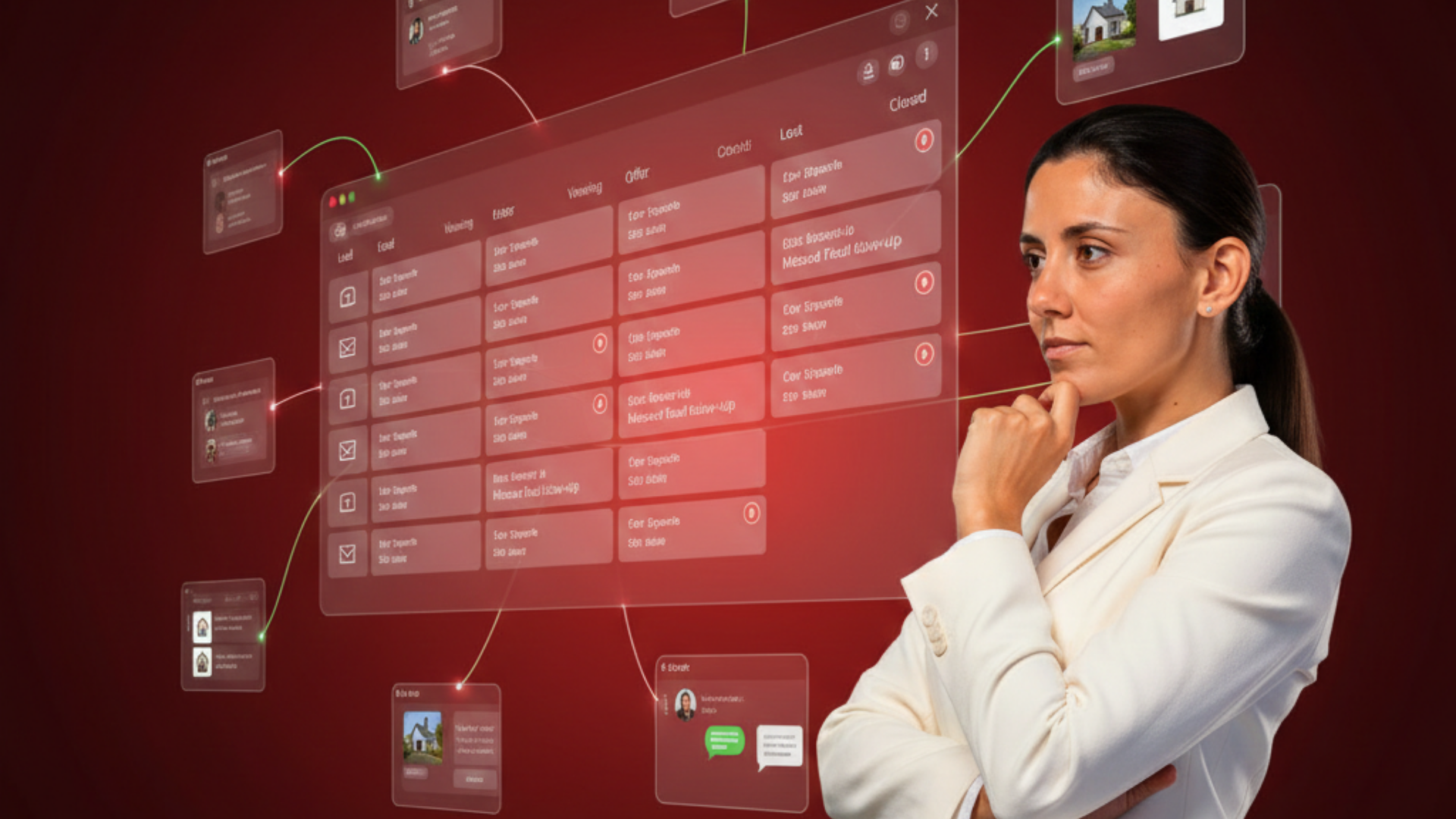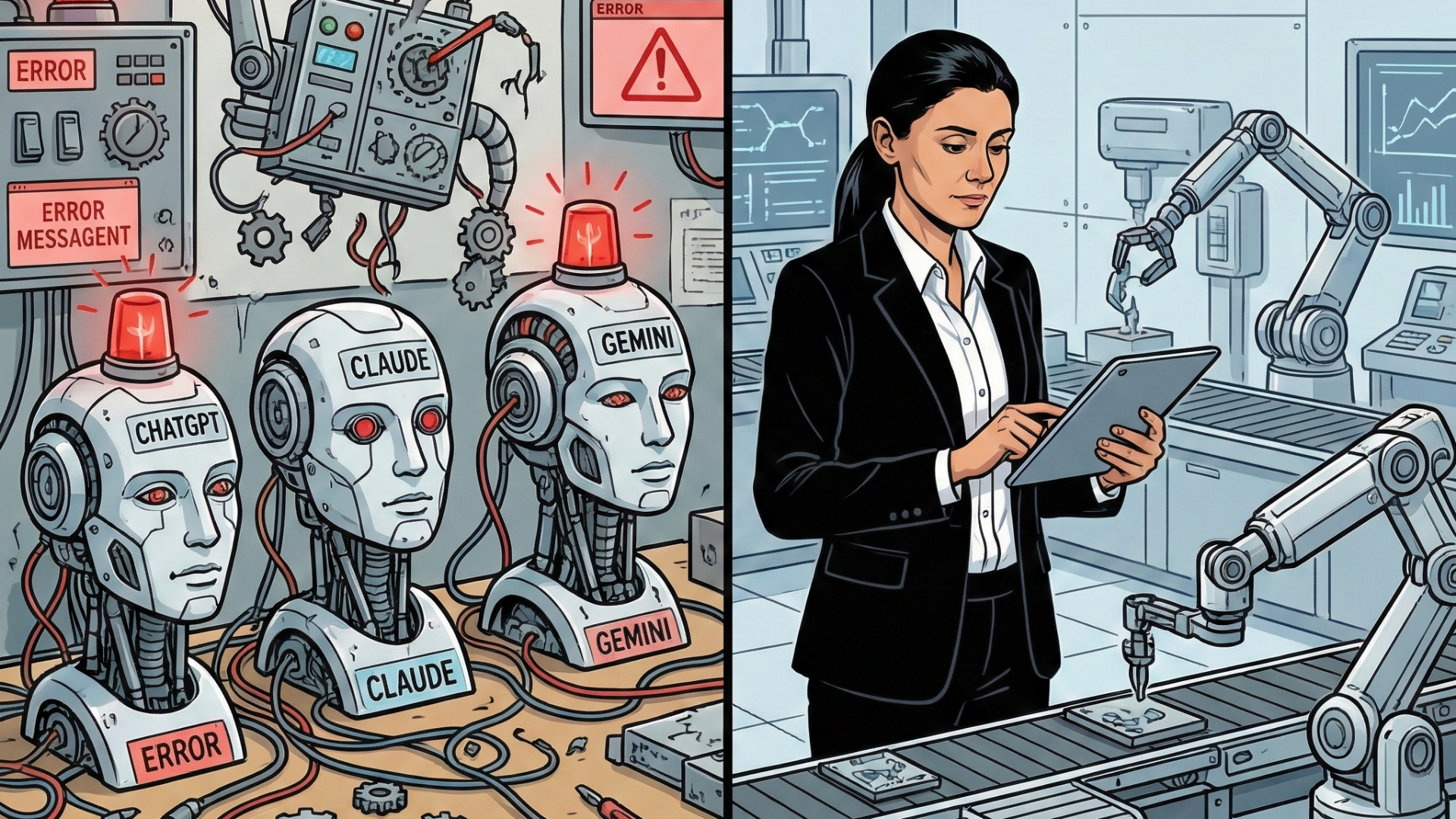

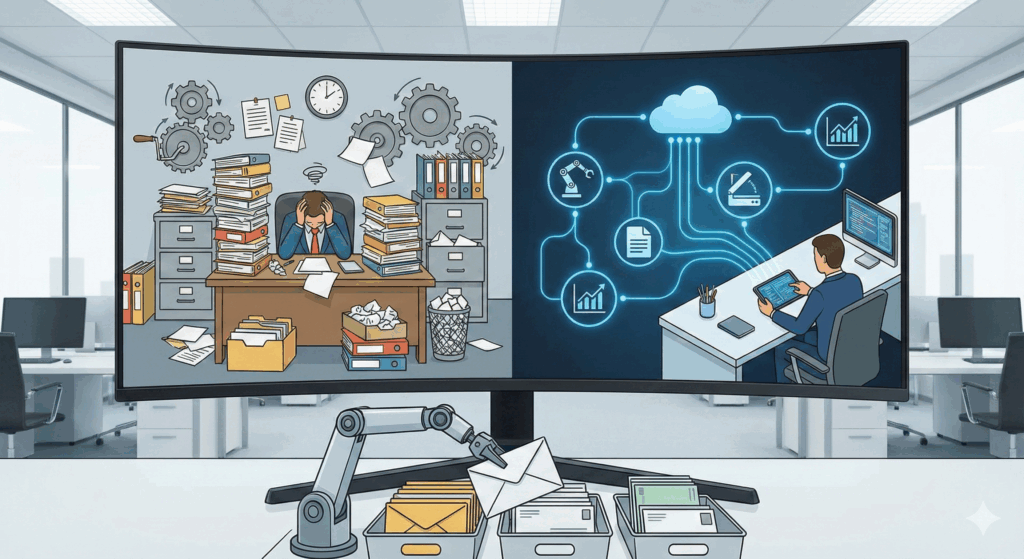
You’re drowning in repetitive work.
Your team is spending hours on tasks that feel important but don’t move the needle.
Information gets lost between emails, spreadsheets, and conversations.
Critical follow-ups slip through the cracks.
And every time you try to grow, the chaos multiplies.
You’ve heard “automation” can fix this. But what does that actually mean?
Business process automation is one of the most frequently used terms in the modern business world and, at the same time, one of the most misunderstood.
For some, automation means expensive software.
For others, it means artificial intelligence replacing people.
For a third group, it’s just another buzzword with unclear real value behind it.
The truth is, most business owners aren’t asking themselves what software to use. They’re asking much more practical questions:
- How do we reduce manual work?
- How do we stop depending on specific people?
- How do we stop missing tasks?
- How do we get more clarity and control?
- How do we grow without chaos?
This article is written precisely for such people.
It’s not a technical guide.
I won’t talk about specific platforms, code, or complex architectures.
I’ll talk about logic, business sense, and real examples.
My goal is to explain what business process automation represents in a way that allows any company owner to recognize themselves in the example and evaluate whether and when this makes sense for their business.
What It Means to Automate a Business Process
Let’s start with the most important thing.
Automation is NOT just software.
Automation is NOT a tool you buy.
Automation is NOT artificial intelligence by itself.
Automation is the execution of a business process with minimal or no human intervention, following clearly defined steps and rules.
It uses software, tools, code, and sometimes artificial intelligence, but it doesn’t start with them. It starts with how work is actually done in your company.
What Actually Is a Business Process?
A business process is any recurring activity that happens in a similar way again and again.
For example:
- Processing inquiries
- Entering and transferring data
- Sending emails
- Preparing reports and summaries
- Checking for missing information
- Classifying clients
- Handing off tasks between people or teams
If an activity is executed with similar logic every time, it’s a process.
And if it’s a process, it can be automated.
The Most Common Mistake in Understanding Automation
Automation does NOT create a new process.
It follows an already existing one.
If today in your company, an employee:
- Receives an email
- Copies information into a spreadsheet
- Checks if data is missing
- Sends a response
- Notifies a colleague
This is already a process. Even if you’ve never described it as such.
Automation simply executes the same steps automatically, with the same logic, without manual participation. Nothing more and nothing less.
Why Is This Critically Important to Understand?
Automation does NOT fix a bad process.
It repeats it faster.
If the process today is chaotic, unclear, or dependent on specific people, automation will accelerate that chaos and make it more expensive.
That’s why every meaningful automation starts not with choosing software, but with understanding the real work.
- What’s happening?
- In what order?
- Who makes decisions?
- Where do errors occur?
- What does the successful result look like?
Only after that come the tools.
Is It Necessary to Automate Everything?
The short answer is no.
The long and honest answer is that not every process is worth automating.
This is one of the most important topics we discuss at the very beginning with potential clients, because this is precisely where the most expensive mistakes are made.
Not Every Process Is Worth It
Automation is an investment.
An investment of time, money, and attention.
If a given process:
- Happens rarely
- Has many exceptions
- Depends on human judgment
- Changes constantly
Then automating it often leads to more problems than benefits.
In such cases, the result is usually:
- Complex automation
- Fragile logic
- A lot of maintenance
- Small real effect
And that’s exactly why the first question is never “can it be automated,” but “does it make sense.”
Some Processes Are Better Left to People
There are processes where the human factor is not just important, but irreplaceable.
Examples include:
- Negotiations
- Making strategic decisions
- Working with complex or emotional customer situations
- Creative activities (although artificial intelligence is advancing in this area, you still can’t rely entirely on it alone)
Attempting to fully automate such processes often results in a poor customer experience or decisions without context.
Automation is not about removing people.
It’s about removing the mechanical part of the work to leave room for thinking, judgment, and value.
Automation Is an Investment, Not a Goal
Many companies start with the wrong motivation:
“We want automation.”
“We want AI.”
“We want something modern.”
But automation by itself is not a goal.
It’s a means to achieve a specific result.
Good automation is always tied to a clearly measurable benefit:
- Less time wasted
- Fewer errors
- Faster response
- Better reporting
- Greater capacity without new employees
If you can’t say what exactly will improve after automation, it’s most likely not yet the time for it.
What Automation Is NOT
To move forward, it’s important to clear up a few more mass misconceptions.
Automation Is NOT “Magic”
Automation does NOT solve problems on its own.
It does NOT “fix itself” if something doesn’t work.
It does NOT think for you.
It executes exactly what it’s been told to do.
Nothing more, nothing less.
If the logic is wrong, automation will execute it wrong, but very quickly and consistently.
Automation Is NOT Replacing People
This is one of the biggest fears we encounter.
In reality, automation:
- Removes mechanical work
- Reduces workload
- Frees up time for more valuable tasks
In most successful projects, people don’t become redundant.
They simply start working smarter.
Automation Is NOT an AI Chatbot for Everything
Artificial intelligence is a powerful tool, but it’s not a solution for every process.
AI makes sense when:
- There’s a need for text analysis
- There’s a lot of unstructured information
- You’re looking for patterns and summaries
But a large part of business processes doesn’t need “intelligence” but rather stable logic, clear rules, and control.
Automation Is NOT a One-Time Project
This is perhaps the most important point.
Automation is not: “we do it once and forget about it.”
Every business evolves.
Processes change.
Requirements grow.
That’s why automation is a system that:
- Is monitored
- Is improved
- Is maintained
And this is exactly where most projects fail.
Why Most Automations Fail and How Not to Be Among Them
The truth is unpleasant, but necessary to say.
Most automations don’t fail because of technology.
They fail because of the way they’re conceived, started, and maintained.
As my experience grew, I began to notice the same mistakes over and over, regardless of industry, company size, or software used.
Lack of a Clearly Defined Process
The most common reason for failure is the lack of a clearly defined process.
There’s no answer to the questions:
- What exactly is happening right now?
- Who does what?
- In what order?
- Where are decisions made?
- When is the process successful?
Instead, there are general descriptions like:
“We process inquiries.”
“We track clients.”
“We make reports.”
Automation can’t work with abstractions.
It works with concrete steps and rules.
When there’s no clarity, you’re automating an assumption, not reality.
Chaos Is Being Automated
Many companies try to use automation to solve an organizational problem.
The process today is:
- Unclear
- Different for each person
- Depends on mood and experience
- Without a standard
Instead of organizing the logic first, they jump directly to automation.
The result is:
- Chaos, but faster
- Errors, but automated
- Problems that are now harder to correct
Automation doesn’t fix a bad process.
It multiplies it.
No KPIs and Measurable Results
Another serious problem is the lack of measurement.
Automations are often done without a clear answer to:
- What exactly will improve?
- How will we measure it?
- After how long do we expect an effect?
Without measurement, automation remains a “feeling,” not a business decision.
And when there’s no clearly measurable result, the first thing to get cut under pressure is precisely the automation.
No Monitoring and Maintenance
Many automations work well… until they stop.
And when they stop, no one realizes immediately.
There are no:
- Logs
- Error notifications
- Execution tracking
In such cases, clients discover problems, not the system.
And that’s the worst possible scenario.
No Process Owner
Automation without an owner is automation without a future.
There must be a clearly defined person or role who:
- Understands the process
- Monitors whether it works
- Makes decisions during changes
- Is the point of contact
Without an owner, automation gradually becomes something “everyone uses” but “no one manages.”
How to Know If Your Company Is Ready for Automation
Here comes the important part.
This section also serves as an honest self-assessment test.
If the answer to most of the following questions is “yes,” you’re probably ready.
Sample Questions to Ask Yourself
- Do you have repetitive tasks that occur daily or weekly?
- Does process execution depend on specific people?
- Do you have clear rules for how information is processed?
- Can you measure the result of a given process?
- Is information lost between different channels?
- Do you miss inquiries or deadlines?
If these problems sound familiar, this is not a weakness. This is a normal stage of business growth.
Automation is not a solution for chaos.
It’s a solution for a mature business that wants control and scalability.
What a Company Gains When It Automates Its Processes (Even Partially)
Automation is not a “technological improvement.”
It’s an operational solution to business problems.
When a company automates its processes correctly, the effect is almost never limited to a single dimension. The change is felt simultaneously in several directions.
Saved Time That Otherwise Disappears Unnoticed
The most obvious benefit is time, but there’s an important nuance here.
We’re not talking about “one big block of time” that magically becomes available.
We’re talking about dozens of small tasks that eat up the day:
- Manual data transfer
- Checking if there’s a new inquiry
- Reminders
- Searching for information
- Preparing reports
Individually, they seem trivial.
Together, however, they add up to hours every week.
Automation doesn’t make people lazier.
It removes mechanical labor that doesn’t bring value.
Reduction of Errors and Oversights
Human errors are not a people problem.
They’re a process problem.
The more manual steps there are, the greater the chance of:
- Missed inquiry
- Incorrectly entered data
- Forgotten follow-up action
- Missed deadline
Automation doesn’t eliminate the need for human judgment, but it eliminates:
- Forgetting
- Different interpretations
- Unsystematic work
The result is a more stable and predictable organization.
Faster Response to Clients and Internal Teams
In many businesses, response speed is critical.
How much time passes from the receipt of the inquiry to the first response?
How much time passes from decision to action?
Automation drastically shortens these intervals because:
- There’s no waiting
- There’s no “I’ll do it later.”
- There’s no dependence on a specific person
The client gets a faster response, and the team works more calmly.
Capacity for Growth Without Constantly Hiring People
This is one of the most underestimated benefits.
Without automation, growth looks like this: more clients → more work → more people.
With automation, part of the growth is absorbed by the systems.
This doesn’t mean people become redundant.
It means they’re used for communication, negotiations, strategy, and real decisions.
Not for copying, checking, and reminding.
Better Transparency and Control
When processes are automated, they become visible.
You know:
- What happened
- When
- Who’s responsible
- What’s the result
This gives owners and managers something very valuable: a real picture, not a feeling.
Which Processes Are Ideal for Automation
Not every process should be automated, and that’s completely normal.
The most suitable processes have several common characteristics.
Repeatability
If a given activity occurs in a similar way repeatedly, it’s a candidate for automation.
Frequency is key.
The more often the process happens, the greater the effect.
Clear Rules
Automation works excellently where there are conditions, logic, and clear decisions.
If it can be described with “if this, then that,” the process is suitable.
High Cost of Errors
When an error costs:
- Money
- Reputation
- Lost client
- Missed opportunity
Automation is often the cheaper solution in the long run.
Clear Result
If you know what the successful end of the process looks like, you can build automation stably.
ROI (High Return on Investment)
Before I start working with a client, I first carefully review the automations they want for their business processes.
Then we sit down and carefully discuss them one by one, separating those that will deliver the greatest return for the time and money invested.
These automations are always in the first phase of every project. All others are distributed across subsequent phases (depending on the project size).
Does Company Size Matter?
The short answer is no.
Automation is not a question of size, but of structure, repeatability, and discipline.
Small companies often have even greater benefits because:
- They don’t have excess capacity
- Every error is felt
- Time is critical
Large companies gain from:
- Scale
- Standardization
- Control
In both cases, automation works when there’s a clear goal.
When NOT to Automate: Red Flags to Watch For
Before we dive into examples, it’s critical to understand when automation is the wrong move.
These are the red flags that tell you to pause:
Your Process Changes Every Week
If your process is still being figured out, automation will lock you into instability.
Wait until the process stabilizes, then automate.
You Can’t Explain the Process in Clear Steps
If you can’t map out the workflow on paper, you can’t automate it.
Automation requires clarity, not guesswork.
The Process Happens Less Than Once a Month
Low frequency means low return on investment.
Your time is better spent elsewhere.
The Task Requires Complex Human Judgment
If success depends on reading between the lines, understanding emotion, or making nuanced decisions, keep humans in the loop.
Automation excels at rules, not wisdom.
You’re Automating to Avoid Fixing a Broken Process
This is the most dangerous trap.
If the process is fundamentally flawed, automation will simply make the problem faster and harder to reverse.
Fix the process first. Automate second.
You Don’t Have Someone to Own It
Automation without a responsible owner becomes abandoned automation.
If no one is accountable for monitoring, maintaining, and improving it, don’t build it.
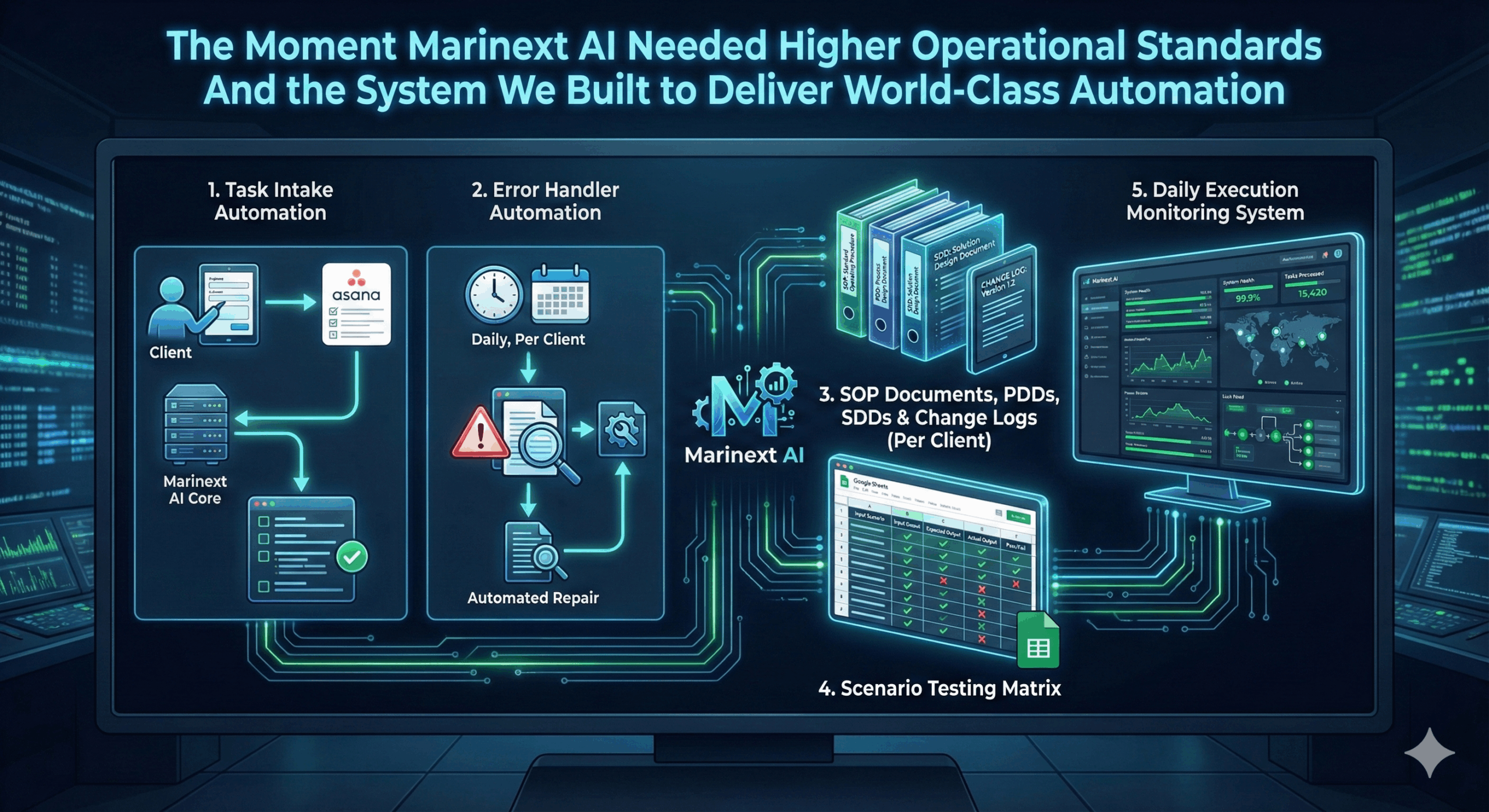
How We Approach Automation at Marinext AI
Here, it’s important to make one clarification.
Never, never, but never do we start with the question: “What software should we use?” We follow the HARDEN™ method, which I created and implemented in the company.
(With the accumulation of experience and projects, the method continues to develop and improve.)
In my company, we always start with:
- Understanding the business
- Measuring reality
- Analyzing processes
- Assessing value
Only after that do we automate what has real value.
And most importantly. After implementation: we monitor, measure, and improve.
Automation is not a project.
It’s a system that lives and evolves together with the business.
Real-World Examples: Automating Business Processes in a Real Estate Agency
Real estate is one of the sectors where automation delivers the fastest, most tangible results.
The reason is simple. Processes are highly repeatable, the volume of information is large, and oversights cost money directly.
Below, I’ll review real examples of automations we built for real estate agencies.
Automating Daily Emails to Brokers
Business Problem
In most agencies, brokers work with multiple potential clients simultaneously. New inquiries come in daily, and existing contacts require follow-up calls.
In reality, this often leads to:
- Missed calls
- Forgotten follow-up actions
- Uneven workload between brokers
How Did the Process Look Before?
Brokers manually check CRM, spreadsheets, or chats.
Some keep notes.
Others rely on memory.
Information is scattered and unstructured.
What Did We Automate?
Every day, the system:
- Collects all new potential clients
- Identifies contacts that require a callback
- Creates a personalized email for each broker
In this email, the broker sees:
- Who do they need to call today
- Why
- What’s the contact’s status
What’s the Real Benefit?
No need for manual tracking.
No forgotten clients.
The workday starts clearly and is organized.
Automating Monthly Reports and Broker Performance
Business Problem
Owners and managers want to know how each broker is performing.
Brokers want clarity on whether they’re doing well or not.
Without automation:
- Reports are done manually
- Data is incomplete
- Analysis is subjective
How Did the Process Look Before?
At the end of the month, someone collects data from different places.
A spreadsheet or presentation is prepared.
Feedback is delayed and often inaccurate.
What Did We Automate?
At the end of each month, the system:
- Calculates key metrics for each broker
- Number of calls
- Number of meetings
- Deposits
- Comparison with set KPIs
Then sends a personalized email with: a summary of performance and a clear focus on what to improve.
What’s the Real Benefit?
Brokers receive objective feedback.
Managers see the real picture.
Improvement is directed where it has the greatest effect.
Automating the Form During Initial Client Contact
Business Problem
The first conversation with a client is key. But often the information:
- Is partially recorded
- Gets lost
- Remains only in the broker’s head
How Did the Process Look Before?
The broker talks on the phone.
Records whatever they can.
Then manually enter information into the CRM, if they do it at all.
What Did We Automate?
During the conversation, the broker fills out a pre-prepared form.
After submission:
- An LLM summarizes the conversation
- Structures key information
- Records it directly in the CRM
What’s the Real Benefit?
Information is complete and structured.
No lost details.
Every subsequent conversation starts from a better position.
Automating Potential Client Analysis
Business Problem
Not all potential clients are the same. But in reality, everyone is often treated the same way.
How Did the Process Look Before?
The broker relies on intuition.
There’s no clear strategy for the next approach.
Important signals are missed.
What Did We Automate?
Several AI agents analyze:
- Responses from advertising campaigns
- The initial conversation
- Additional information
The system creates:
- A client profile
- An approach recommendation
- Questions for the next meeting
What’s the Real Benefit?
More personalized approach.
Higher success rate.
Less time wasted with unsuitable clients.
Dashboard for Broker Performance
Business Problem
Decisions are made based on feeling, not data. The owner and managers wanted to be able to visually see the company’s overall performance and each broker’s performance by month.
How Did the Process Look Before?
Scattered spreadsheets. No overall picture.
What Did We Automate?
We built a dashboard that visualizes:
- Results by month
- Results by period
- Comparison between brokers
- AI analysis of results against set KPIs
- Ability to download the selected report
What’s the Real Benefit?
Management sees reality in real time.
Decisions become faster and more accurate.
These are just some of the automations we’ve built in this industry.
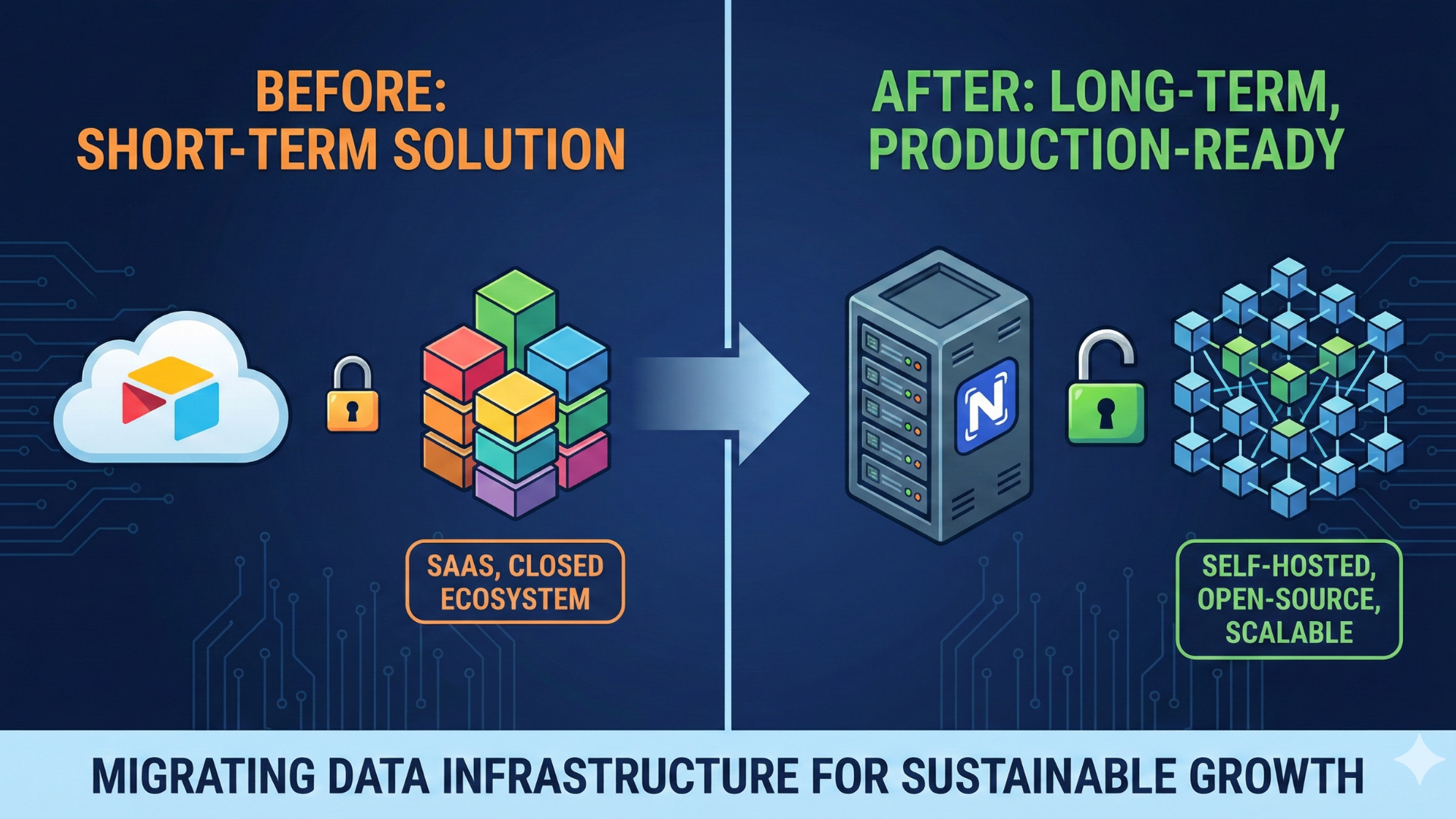
Perhaps the most valuable thing we’ve managed to do for real estate agencies is build them a proper database. To restructure what they have in Google Sheets and rebuild it in software adequate for the purpose.
Real-World Examples: Automating Business Processes in a Logistics Company
Logistics is a sector where automation directly affects profit.
Time, accuracy, and response are critical.
Automating Price Lists for Groupage
Business Problem
Preparing quotes is slow and error-prone.
How Did the Process Look Before?
The forwarder collects data.
Calculates manually.
Checks spreadsheets.
What Did We Automate?
- Form for data entry
- Algorithms calculate the current price for the week
- The system sends a ready email with the final price
What’s the Real Benefit?
Faster quotes.
Fewer errors.
Better competitiveness.
Outlook AI Agent for the Sales Team
Business Problem
Email communication is chaotic and difficult to measure.
What Did We Automate?
- Generating draft emails
- Tracking emails without a response
- Measuring response time
- Checking for missing information
What’s the Real Benefit?
Better discipline.
Higher speed.
Better control over sales.
Automation for Classifying Tickets in Zendesk
Business Problem
Large volume of incoming tickets. 15 minutes of mechanical labor to classify one ticket.
What Did We Automate?
Two-layer model:
- Rules with custom code
- AI model for unclear cases
What’s the Real Benefit?
Faster distribution.
Less manual work.
Better service.
What’s Next
If you recognized your business in these examples, you probably already sense where automation makes sense and where it doesn’t.
The next step is not “to automate everything.”
The next step is to understand what’s worth it.
And that’s exactly where every meaningful automation begins.
Conclusion: Automation Is a Decision, Not a Trend
Let me be direct.
Automation is not about buying software.
It’s not about chasing trends.
It’s not about replacing your team with robots.
Automation is about building a business that can scale without breaking.
It’s about freeing your people from mechanical work so they can focus on what actually matters: strategy, relationships, decisions, and growth.
But here’s the hard truth most won’t tell you:
Bad automation is worse than no automation.
If you automate chaos, you get faster chaos.
If you automate without monitoring, you get silent failures.
If you automate without a plan, you waste money and trust.
That’s why we built the HARDEN™ method. Not to automate faster, but to automate right.
The Three Questions Every Business Owner Should Ask Before Automating
Before you spend a single dollar or hour on automation, answer these:
- Can I clearly describe this process in steps?
- If no, you’re not ready yet.
- Will this automation create measurable value?
- If you can’t measure it, you can’t improve it.
- Who will own this after it’s built?
- Automation without ownership dies slowly and expensively.
If you can answer all three confidently, you’re ready.
If not, you’re about to waste time and money.
What Separates Successful Automation from Failed Projects
After years of building automation systems for companies across industries, I’ve seen a clear pattern.
Successful automations share three characteristics:
- They solve a real pain point – Not a theoretical problem, but something that actively hurts the business today.
- They’re monitored from day one – Success isn’t launching the automation. It’s knowing when it breaks and fixing it before anyone notices.
- They evolve with the business – The best automations aren’t static. They grow, adapt, and improve as your business changes.
Failed automations share three characteristics too:
- They’re built on assumptions – “We think this is how it works” never survives contact with reality.
- They’re abandoned after launch – No monitoring, no maintenance, no improvement. Just silent decay.
- They’re disconnected from business goals – If you can’t tie automation to revenue, efficiency, or customer satisfaction, it’s just expensive technology.
Your Business Deserves Better Than “Set It and Forget It”
There’s a dangerous myth in the automation world:
“Build it once, and it runs forever.”
This is a lie.
Every business evolves. Markets shift. Teams change. Processes mature.
The automations that worked six months ago might be holding you back today.
That’s why at Marinext AI, we don’t just build automation systems.
We build systems that are designed to be observed, measured, and improved.
Because the moment you stop paying attention is the moment automation stops serving your business.
Ready to Automate the Right Way?
If you’ve read this far, you’re not looking for quick fixes or magic solutions.
You’re looking for a partner who understands that automation is a strategic decision, not a technical checkbox.
You want:
- Clarity on what’s worth automating
- Honest assessment of what’s not ready yet
- A roadmap that ties automation to real business outcomes
- A system that evolves with your company
That’s exactly what we do.
Book a free consultation and let’s map out where automation makes sense for your business.
No sales pitch. No pressure. Just an honest conversation about your processes, your challenges, and whether automation is the right move right now.
👉 Schedule your consultation here
One Final Thought
The companies that win in the next decade won’t be the ones with the most automation.
They’ll be the ones with the right automation.
The ones who understood that technology is a tool, not a strategy.
The ones who built systems that serve their people, not replace them.
The ones who knew when to automate, when to wait, and when to say no.
That’s the difference between automation that transforms a business and automation that just adds complexity.
Which one do you want?